BCBS 239, GDPR, and the lineage problem: what audit-ready data governance actually looks like in 2026

Three regulatory pressures, one underlying capability gap. Here's the practical playbook - and how Dawiso solves each piece.
Ask any Risk and Regulatory Compliance team in a European bank what's on the 2026 roadmap, and three items show up on almost every list: end-to-end data lineage, PII flow documentation under GDPR Article 30, and BCBS 239 evidence that holds up under supervisory review.
These aren't separate projects. They're the same underlying capability viewed from three different regulatory angles. And the way most banks document this work today - spreadsheets, static diagrams, manual mappings, knowledge in senior engineers' heads - was never designed to produce the evidence that current supervision actually requires.
This piece is a practical walk-through: what each of these three problems looks like from the inside, what a modern solution needs to do, and how Dawiso handles it. No abstract theory, no buzzwords. The teams reading this already know the problem.
The three regulatory pressures, and why they share one solution
BCBS 239 - from principles to enforcement
BCBS 239 has been around since 2013, but the supervisory posture changed materially in 2023-2024. ECB's 2024 Guide on Effective Risk Data Aggregation and Risk Reporting set explicit supervisory expectations, and the 2023 SREP cycle flagged risk data weaknesses across large banks and tied them to capital implications. The supervisor is no longer asking whether you have a documented lineage from source systems to regulatory reports - they're asking to see it, end-to-end, on demand.
In practice, this means the Head of Risk Reporting needs to answer questions like: "Where does the credit exposure figure in this Pillar 3 report come from? Which source systems feed it, what transformations happen, who approved the logic, and when did it last change?" - and the answer needs to be a system query, not a three-week reconstruction project.
GDPR Article 30 and PII flow tracking
Article 30 requires a continuously current record of processing activities - which means the DPO has to know, at any moment, where personal data lives, how it flows between systems, who has access, and on what legal basis. The 2024-2025 enforcement wave against financial services made this concrete: several supervisory authorities issued seven-figure fines specifically tied to banks' inability to produce credible data flow documentation.
The challenge is that PII doesn't sit still. A column tagged "customer_id" at ingestion gets joined, transformed, copied into reporting marts, fed into analytical models, and surfaced in dashboards. Without automation, the DPO is constantly rebuilding the picture under deadline.
DORA, AI governance, and the compounding documentation burden
DORA went live in January 2025 and added ICT third-party risk and operational resilience to the lineage conversation. At the same time, every internal AI initiative - fraud detection, KYC, credit decisioning, internal copilots - needs to answer "where does the training data come from and how do we know it's correct?" under model risk management review.
All of this points to the same underlying need: a governance layer that knows what data exists, where it comes from, how it moves, what it means, and who's responsible for it - and that maintains itself as the data landscape changes. That's the capability gap. And it's what Dawiso is built for.
What Dawiso does, feature by feature, with real scenarios
Interactive data lineage with column-level depth where it matters
Dawiso's data lineage ingests automatically from the platforms that already know what's happening - data warehouses, ETL and orchestration tools, BI layers, transformation frameworks like dbt. Table-level lineage covers the breadth of your landscape; column-level lineage comes in where the regulatory question demands it (which, for BCBS 239 and Article 30, is most of the time).
The lineage view is bidirectional and interactive. A risk analyst can click on a specific figure in a Pillar 3 report and trace upstream to the source system, seeing every join, transformation, and approval along the way. A data engineer planning a change to a source table can click downstream and see exactly which reports, dashboards, and models depend on the field they're about to modify.
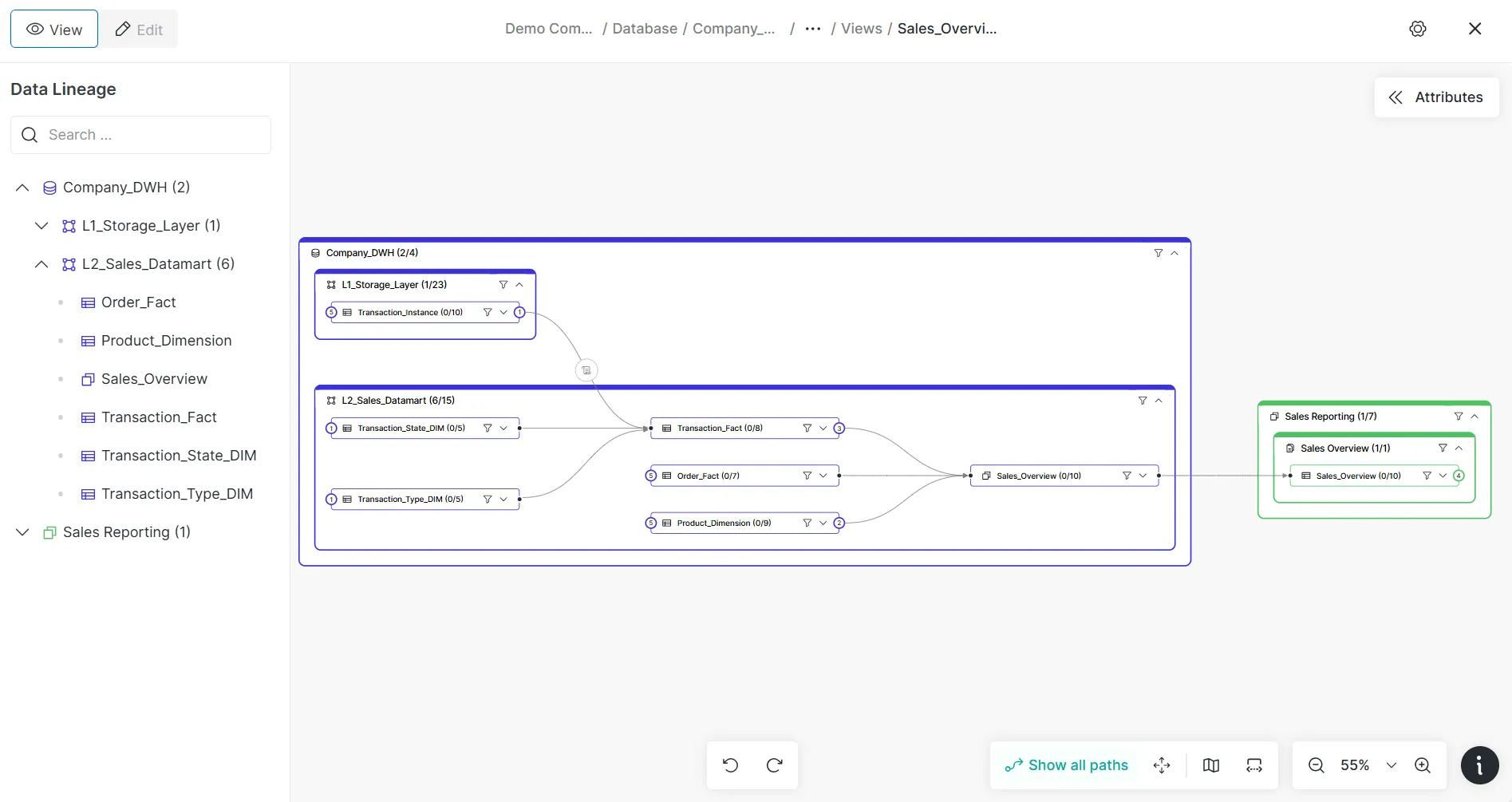
Scenario. A supervisor asks how the Risk team can be sure the LCR figure in last quarter's COREP submission was correct on the filing date. In a spreadsheet world, this becomes a multi-week reconstruction. With Dawiso, the risk analyst opens the lineage view for the LCR field, sees the upstream sources, the transformation logic, the approval trail, and the version history, and exports the view as a PDF for the supervisor. The conversation closes the same day.
Impact analysis before the change ships
The lineage isn't just historical documentation - it's a forward-looking decision tool. Before a change is approved in a source system, Dawiso shows which downstream assets depend on the field, which of them are tagged as regulatory, PII, or critical, and who owns them.
Scenario. A data engineer plans to rename a column in the customer master table. Before the change is approved, the impact view in Dawiso shows that the column feeds 47 downstream tables, 12 of which are tagged "regulatory reporting," 3 of which are tagged "GDPR PII," and 8 of which are owned by the Risk Reporting team. The change gets routed through the right approvals before it breaks the Pillar 3 pipeline at month-end.
PII tagging that propagates automatically
This is where lineage and GDPR converge. Tag a column once at the source as containing personal data, and Dawiso propagates the tag downstream as the data moves. If a GDPR-tagged column flows into a new table through a join, the new table inherits the tag - and the DPO has a continuously current record.
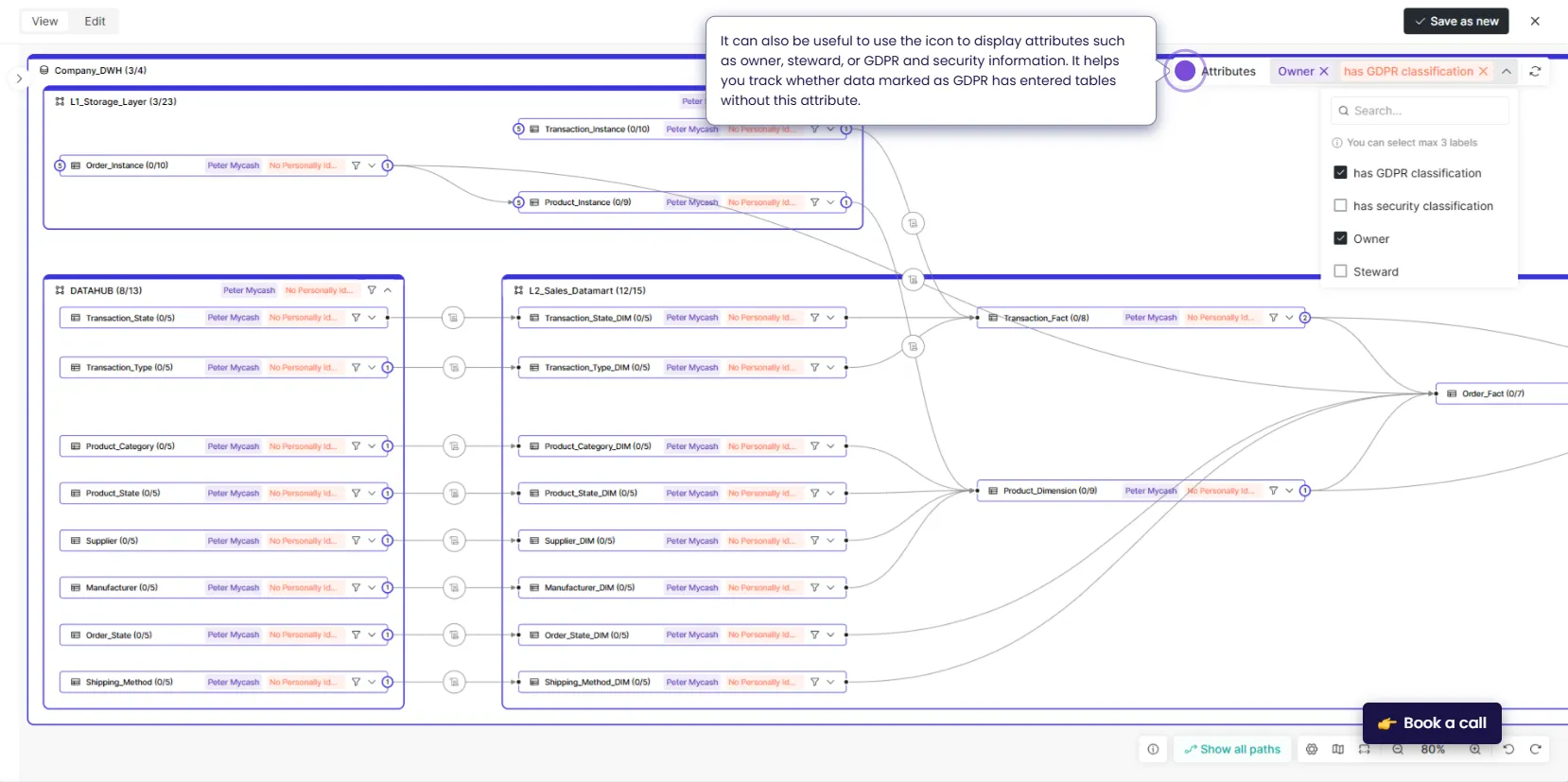
Scenario. The DPO needs to respond to a regulator's question about where customer payment data is processed across the bank's analytical environment. Instead of emailing six data engineers, the DPO opens Dawiso, filters by the GDPR tag, and sees every system, table, and downstream consumer where the data resides - with the lineage trail showing how it got there. Article 30 documentation becomes a query, not a quarterly project.
See it in action
See it in action: Interactive Data Lineage
Click any field in a report and trace it back to source - joins, transformations, approvals, the lot.
Business glossary that links definitions to actual data
A Risk Officer reads "RWA" and needs to know which calculation engine produced it, which definition the business agreed to, and which report it feeds. A data engineer reads "RWA" and needs the column, the dependencies, and the upstream joins. The Dawiso business glossary links business terms to the technical assets that implement them - so both audiences see the same source of truth at the level of detail they need.
For regulatory work, this matters because the supervisor's questions are almost always asked in business language ("show me how exposure is calculated") and have to be answered in technical evidence ("here is the table, here is the transformation, here is the approval"). The glossary is the bridge.
Audit trails that hold up under review
Every change to a definition, every approval, every modification to lineage - versioned, time-stamped, attributable. When the supervisor asks "how did you know this Pillar 3 number was correct on the date you filed," the answer is a record. The same audit trail covers GDPR change-of-processing documentation and BCBS 239 Principle 6 (Adaptability).
Catalog automation that removes the manual layer
Most of what kills data governance programs isn't strategy - it's the unsustainable manual work of keeping documentation current. Dawiso ingests metadata automatically from connected systems, suggests classifications, links related assets, and flags drift. A deeper write-up of where automation actually saves time for governance teams is here: How data catalog automation saves hours of manual work.
Built for European financial services
A few things worth knowing if you're scoping Dawiso against the alternatives.
The platform is designed around the workflows Risk, Compliance, and CDO offices actually run - not a generic catalog repurposed with banking screenshots. The Banking and Financial Services solution reflects how regulated financial data is governed in practice. Our framing of why BCBS 239 matters more than ever in 2025 and beyond is the same framing we use with bank clients.
Proven at scale. One of our clients - a Czech bank that is part of a major international financial group - runs Dawiso as the single metadata hub for 30+ financial institutions in the group: 370,000+ data warehouse tables, 2,000+ reports, 6,500 business terms in one workspace, with scanners for Teradata, Oracle, PostgreSQL, Cognos, PowerBI, PowerDesigner, Manta, and orchestration tooling. The full breakdown is in the KB Group case study.
More European customer stories. Including a large European insurer running Dawiso as their internal data portal across 5,900+ users and more than 3.4 million objects. The full set of case studies is on the site.
Enterprise deployment. SOC 2 Type II, ISO 27001, and ISO/IEC 27018 certified. Flexible deployment options for banks with strict architectural and data residency requirements - details on the Enterprise Deployment page.
The short version
BCBS 239, GDPR Article 30, and DORA are asking for the same underlying capability: a governance layer that knows where data comes from, how it moves, what it means, and who owns it - and that maintains itself as the landscape changes. Dawiso is built for that capability, in the specific shape that European banks need it.
If the 2026 roadmap has data lineage, PII flow documentation, or BCBS 239 evidence as named priorities, the practical next step is a 30-minute walkthrough on a realistic scenario.
See Dawiso on a real Risk Reporting scenario. Book a demo - we'll walk through BCBS 239 lineage, PII tracking, and impact analysis. No slides, just the product.
Further reading
- What banks need to know in 2025: why BCBS 239 matters more than ever
- BCBS 239 in 2025: why now is the time to strengthen compliance
- BCBS 239: 5 data catalogs to support risk data governance
- Interactive Data Lineage - product page
- Banking and Financial Services solution overview
- KB Group case study - one hub connecting 30+ financial institutions
- All customer case studies